
The Energy Transition Has a Misalignment Problem — And Some Actors Benefit From It
Not all inefficiency destroys value.
In parts of the system, it redistributes it — and persists as a result.
The energy transition is widely described as a system under strain, shaped by capital intensity, regulatory complexity, permitting delays, grid constraints, and the growing pressure to deliver infrastructure at unprecedented speed and scale. This framing is not incorrect, but it is incomplete.
It assumes that inefficiency is a by-product of complexity and that misalignment emerges primarily because the system is struggling to coordinate itself under pressure.
What it does not sufficiently examine is the persistence of inefficiency in conditions where the system continues to function, capital continues to be deployed, and participants remain commercially active. In that context, misalignment cannot be understood purely as failure. It must also be understood as a condition the system is, in certain respects, structurally capable of sustaining.
This distinction matters because systems that are forced to correct misalignment behave very differently from those that can absorb it. Where inefficiency leads directly to value destruction, corrective pressure is immediate and unavoidable, and alignment becomes a prerequisite for continued operation. Where inefficiency allows value to persist, the urgency to resolve it weakens, and the system adapts around the misalignment rather than eliminating it.
The energy transition increasingly exhibits characteristics of the latter condition. It is not simply that projects encounter difficulty; it is that many of them continue to progress, albeit in altered, extended, or suboptimal forms, without triggering a structural reset. This reveals something more fundamental than execution challenge. It reveals a system in which alignment is not fully coupled to value.
At the point of financial close, a project is typically regarded as having achieved a form of structural legitimacy. Risk has been allocated across contractual frameworks, financial models have been tested against a range of scenarios, and capital providers have accepted the underlying assumptions as sufficient to support investment. The designation of “bankable” carries weight in this context, as it signals that the project has passed the threshold required to proceed.
However, bankability reflects a moment of confidence in a defined set of assumptions; it does not guarantee that the interfaces between stakeholders, delivery pathways, and system dependencies will remain coherent as those assumptions encounter real-world conditions. In practice, many of the most consequential misalignments only emerge after this point, when the abstraction of financial and contractual models gives way to the realities of implementation.
As projects move into execution, the conditions under which they were structured begin to shift. Grid connection timelines move, often in response to wider system constraints that were not fully accounted for at the time of approval. Permitting processes extend beyond anticipated durations, influenced by administrative capacity, political considerations, or community engagement dynamics. Technical interfaces reveal dependencies and incompatibilities that were either underestimated or deferred during earlier design phases. Supply chain pressures alter sequencing assumptions, introducing delays or requiring substitutions that affect both cost and performance. Policy environments evolve, sometimes subtly and sometimes materially, reshaping the economic or regulatory landscape in which the project operates.
None of these developments are unusual in isolation, but their cumulative effect is to introduce misalignment across multiple dimensions of the project simultaneously.
What follows is rarely immediate failure. Instead, the project enters a prolonged phase of adjustment in which the original structure is incrementally modified to accommodate emerging realities. Timelines are extended, contractual terms are revisited, financing arrangements are restructured, and additional advisory input is introduced to navigate the evolving landscape. From a system perspective, this phase is often treated as part of the normal lifecycle of complex infrastructure delivery.
However, what is less frequently interrogated is the fact that during this period of adjustment, value continues to circulate through the system. Advisory mandates extend as additional structuring and negotiation are required, financial institutions engage in refinancing or restructuring processes, contractors adapt their positions in response to revised timelines and conditions, and developers remain active in managing the evolving configuration of the project.
This continuity of economic activity is critical to understanding why misalignment persists. The mechanisms that are used to manage misalignment are not purely corrective; they are also commercially active. They generate fees, margins, and continued engagement across multiple actors, even as the underlying project deviates from its original trajectory.
In this sense, inefficiency does not necessarily equate to economic inactivity. A project can be delayed, reconfigured, and operating below its optimal state while still supporting a network of transactions and value exchanges. This creates a condition in which misalignment is not immediately punished by the system, but instead absorbed and redistributed across its participants.
This condition is not limited to individual projects. It is visible at the level of the system itself. Despite widespread constraints across permitting, grid integration, and delivery, capital deployment continues to expand.
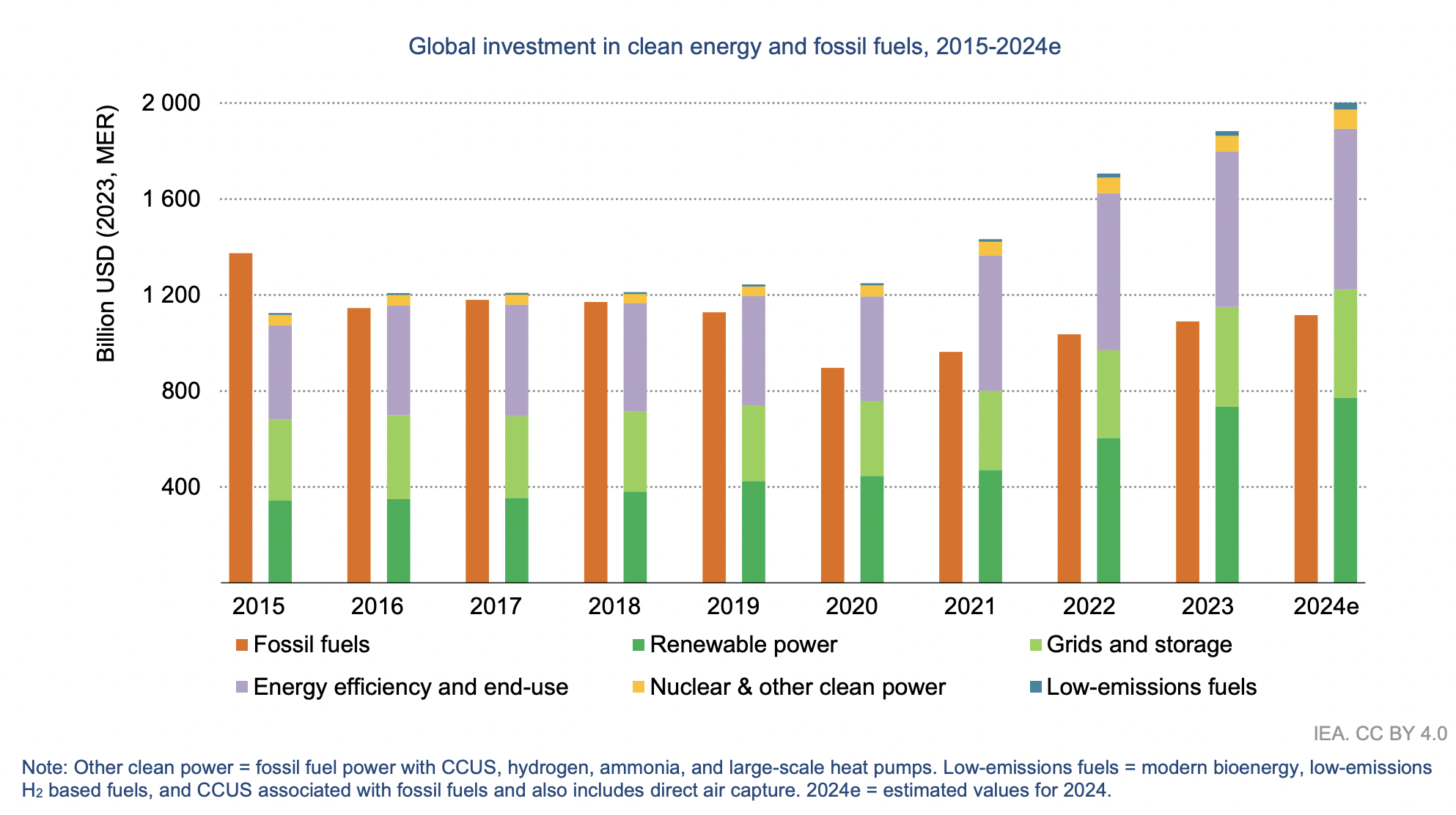
According to the International Energy Agency, global energy investment reached approximately $3 trillion in 2024, with $2 trillion going to clean energy technologies and infrastructure. The system is therefore not responding to inefficiency by slowing down. It is continuing to scale while carrying that inefficiency forward.
International Energy Agency (IEA) - World Energy Investment 2024
When inefficiency remains economically survivable, it ceases to function as a forcing mechanism for systemic correction. Instead of triggering rapid realignment, it becomes part of the operating environment, something to be managed rather than eliminated. Over time, this leads to a structural pattern in which misalignment is not an exception but a recurring feature of how projects evolve.
Empirical evidence reinforces this condition. Large-scale infrastructure delivery does not operate within tight tolerance bands; it operates within systemic deviation. Studies led by Bent Flyvbjerg, based on hundreds of projects across multiple geographies, show that approximately 86% of large infrastructure projects experience cost overruns, with an average escalation of around 28%. In many cases, overruns extend significantly beyond this range.
The implication is not simply that projects underperform. It is that they continue despite doing so. Cost deviation at this scale does not remove projects from the system. It is absorbed within it.
Delays are accommodated within revised timelines, cost increases are absorbed within adjusted financial structures, and coordination challenges are addressed through additional layers of management rather than fundamental redesign. The system, rather than converging towards alignment, adapts to the presence of misalignment and continues to operate within it.
It is important to emphasise that this condition does not arise from deliberate intent on the part of individual actors. Participants across the system are generally responding rationally to the incentives and constraints they face. Advisory firms provide additional services when projects require further structuring or renegotiation. Capital providers adjust terms and structures in response to changing risk profiles. Developers navigate regulatory and technical challenges as they emerge, seeking to maintain project viability. Contractors manage execution within the boundaries of their contractual obligations, adapting to revised conditions where necessary. Each actor is operating appropriately within their domain, and in many cases, contributing positively to the continuation of the project.
The issue, therefore, is not one of behaviour but of structure. The system as a whole does not enforce alignment as a prerequisite for value creation. Instead, it allows value to be created and captured even when alignment is partial, delayed, or fragmented. This creates a form of structural tolerance in which inefficiency is not eliminated but integrated into the ongoing operation of the system.
The consequences of this tolerance are not always immediately visible, as the system continues to produce outputs in the form of deployed capital and constructed infrastructure. However, over time, the cumulative impact of misalignment manifests in extended timelines, increased costs, and reduced overall efficiency at the system level.
As the scale and urgency of the energy transition increase, this dynamic becomes more pronounced. The demand for rapid deployment of generation capacity, storage systems, grid infrastructure, and electrified transport is accelerating, driven by policy commitments, technological advancement, and shifting economic priorities. At the same time, the system through which these assets are delivered remains subject to the same structural conditions that allow misalignment to persist.
As more projects move through the system, the cumulative effects of inefficiency begin to compound, creating pressures that extend beyond individual projects and into the broader system architecture. Grid constraints in one area affect the viability of projects in another, supply chain disruptions ripple across multiple developments, and delays in permitting or financing create bottlenecks that slow overall progress.
In this context, the persistence of value flow under misaligned conditions becomes increasingly consequential. It means that the system can continue to expand while carrying forward embedded inefficiencies, effectively scaling misalignment alongside capacity. From a distance, progress is visible in the form of increased investment, new infrastructure, and growing deployment figures.
However, beneath this surface, the system is operating with a level of friction that reduces its ability to deliver at the speed, cost, and coherence required to meet its objectives. The risk is not that the transition will fail outright, but that it will proceed in a manner that is structurally suboptimal, requiring increasing levels of intervention to maintain momentum.
This raises a fundamental question about how the energy transition is currently structured. If alignment is not inherently linked to value creation, what mechanisms exist to ensure that it is prioritised? If inefficiency can coexist with ongoing economic activity, what forces are sufficient to drive systemic correction? And if misalignment is allowed to persist at scale, what are the long-term implications for the effectiveness and resilience of the infrastructure being built?
These questions do not have simple answers, but they point to a critical shift in perspective. The challenge of the energy transition is not only to mobilise capital and deploy technology, but to ensure that the system through which these actions occur is structured in a way that enforces coherence across its components. Without this, the transition risks becoming a process in which progress is achieved, but at a cost that is higher, slower, and more fragmented than necessary.
The prevailing assumption that inefficiency will naturally be resolved as the system matures is not supported by the dynamics currently observable. Systems do not self-correct simply because inefficiency exists; they correct when inefficiency disrupts value to a degree that makes its continuation untenable. Where inefficiency remains compatible with ongoing value creation, the pressure to correct it is diminished, and the system continues to operate within its existing structure.
The energy transition, as it stands, reflects this condition. It is advancing, but not fully aligned; it is delivering, but not always coherently; it is mobilising capital, but not consistently translating that mobilisation into optimised execution. This is not a temporary phase that will resolve itself through scale alone. Without structural mechanisms that more tightly couple value to alignment, the system will continue to tolerate misalignment as part of its operation.
A system that tolerates misalignment cannot be expected to correct itself.
Not because the actors within it lack capability or intent, but because the conditions required for correction are not structurally embedded.
Until alignment becomes inseparable from value, rather than merely desirable alongside it, misalignment will remain not just a challenge within the energy transition, but a defining characteristic of how it currently functions.