
When Deployment Outruns Design
Why sequencing, not raw acceleration, determines the resilience and velocity of national energy systems
Across advanced and emerging economies alike, energy transition is accelerating at historic speed. Renewable generation capacity continues to expand, storage deployment is scaling, electrification strategies are reshaping industrial demand, and digital infrastructure is increasing baseline load requirements. Capital is flowing into low-carbon infrastructure at unprecedented levels, and governments are under pressure to demonstrate measurable progress against national commitments.
Acceleration is necessary. The scale of the transition demands it.
But acceleration alone does not guarantee durability.
In many jurisdictions, deployment is advancing faster than institutional and physical system design. Assets are being introduced into grids, markets and regulatory environments that have not been structurally recalibrated to absorb them at scale. The imbalance is not immediately visible, but it produces cumulative strain that eventually slows the very momentum acceleration was meant to create.
Energy systems are not strengthened by accumulation alone. They are strengthened by sequencing.
Sequencing and speed are not mutually exclusive. In fact, disciplined sequencing is what allows systems to scale faster over time. When enabling layers — transmission reinforcement, market rule stability, tariff alignment, capital structuring and institutional accountability — are advanced in deliberate sequence, friction declines and replication accelerates.
When they are not, early acceleration generates bottlenecks that reduce long-term velocity.
The prevailing model of transition often prioritises visible deployment: procure generation capacity, deploy storage, incentivise electrification. Transmission expansion, regulatory reform and market evolution frequently move more slowly. When deployment outpaces these enabling layers, complexity expands faster than coherence. Projects reach completion, but system constraints accumulate.
This dynamic is increasingly reflected in global reporting. The International Energy Agency has warned that grid infrastructure expansion must accelerate substantially this decade to support climate and energy security objectives, effectively requiring a dramatic increase in transmission and distribution investment. Yet in multiple regions, generation deployment continues to exceed grid reinforcement capacity. Renewable approvals surge while connection backlogs lengthen.
Interconnection queues in major markets now represent capacity levels that rival or exceed existing installed fleets.
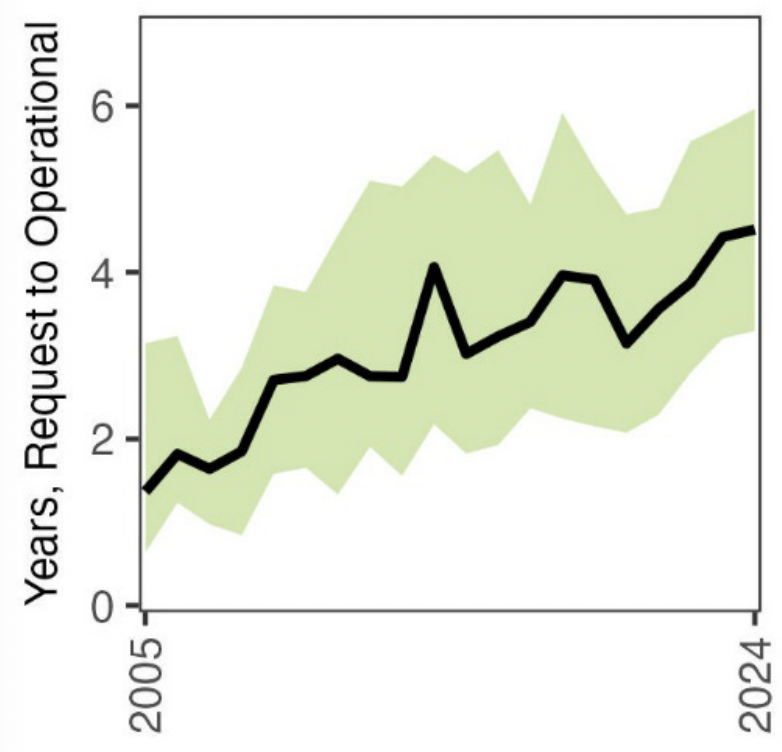
Of projects requesting grid interconnection between 2000 and 2019, only 19% had reached commercial operation by the end of 2024. The typical project built in 2024 spent 55 months between request and operation — up from 36 months in 2015 and 22 months in 2008.
— LBNL, Queued Up 2025 Edition
Deployment is accelerating. System absorption is not.
When generation scales ahead of transmission reinforcement, curtailment rises and effective output declines. When storage is deployed before market structures fully monetise flexibility services, revenue durability weakens. When electrification policies stimulate demand without parallel distribution reinforcement, reliability pressures intensify and cost recovery becomes politically sensitive.
In each case, acceleration precedes system readiness. The result is delay — not because technology failed, but because sequencing discipline was absent.
At sovereign scale, these sequencing failures compound. Procurement cycles operate within fiscal calendars and political cycles. Transmission corridors, regulatory reform and tariff restructuring require longer planning horizons and cross-ministerial alignment. Visible assets generate immediate political credit; invisible sequencing architecture does not. The incentives are asymmetric.
But the long-term effect of mis-sequenced acceleration is reduced system velocity.
Major international outlooks, including those from IRENA, consistently emphasise that high shares of renewable energy require parallel investment in enabling infrastructure — flexibility mechanisms, transmission expansion and regulatory adaptation. System integration must evolve alongside capacity growth. Where sequencing lags, integration friction increases and effective deployment slows.
The sequencing challenge extends beyond physical infrastructure into capital structuring. Financial models frequently assume stable market participation frameworks and predictable ancillary service revenues. If assets are financed on revenue structures that depend on regulatory reforms not yet embedded in law or regulation, uncertainty rises. Capital becomes cautious. Replication timelines stretch.
Long-duration infrastructure capital does not resist acceleration. It resists unpredictability.
When sequencing is disciplined, confidence increases and financing accelerates. When sequencing is weak, early speed generates later hesitation.
This is not an argument for slower transition. It is an argument for structured acceleration.
Energy transition at national scale is an exercise in institutional choreography. Grid expansion must be sequenced with generation targets. Market rules must stabilise before revenue stacking assumptions are embedded into financing structures. Distribution networks must be reinforced before electrification incentives materially increase load. Institutional accountability must precede large-scale capital commitments to ensure that replication pathways remain viable.
Optimisation improves components. Sequencing determines how components scale.
When deployment outruns design, strain accumulates invisibly until it becomes politically and financially visible — through rising curtailment, tariff pressure, regulatory revisions and investor hesitation. These are not technological setbacks. They are velocity setbacks caused by sequencing failure.
The central policy question is therefore not whether to accelerate, but how to sequence acceleration so that speed compounds rather than collapses.
Acceleration without sequencing produces bottlenecks. Sequencing with acceleration produces durable momentum.
The next phase of energy transition will distinguish between systems that pursue raw speed and systems that pursue structured speed. The former will encounter recurrent friction. The latter will scale with increasing stability and declining marginal delay.
The question is no longer how fast nations can build. It is whether what they build can move at system speed.