
Energy Transition Without Architecture Is Just Procurement
Why national energy ambitions are advancing faster than the institutional architecture required to sustain them
National energy transition programmes are advancing at unprecedented speed. Installed renewable capacity continues to grow across both advanced and emerging economies. Storage deployment is scaling rapidly, electrification strategies are embedded in industrial policy, and digital infrastructure is reshaping national demand profiles. Public and private capital are increasingly aligned with decarbonisation goals, and governments face strong pressure to demonstrate visible progress.
From a deployment perspective, momentum appears decisive. Yet beneath this acceleration lies a structural imbalance. In many jurisdictions, infrastructure expansion is advancing more rapidly than the institutional architecture required to sustain it. Procurement cycles are moving faster than system design. Assets are being added to grids and markets that have not been structurally recalibrated to absorb them at scale.
The distinction between procurement and architecture is not semantic. Procurement is a delivery mechanism: it converts policy intent into contracts and contracts into infrastructure. It generates tangible outputs — megawatts installed, substations commissioned, storage systems deployed — and it is visible, reportable and politically legible.
Architecture, by contrast, defines how generation, storage, transmission, demand, tariff frameworks, regulatory institutions and capital recovery mechanisms will interact over the long term. It establishes sequencing across ministries and agencies, aligns infrastructure targets with transmission planning and revenue logic, and embeds accountability at system level rather than project level. Without this foundation, deployment becomes a collection of projects rather than a coherent national system.
The distinction matters because energy systems are not merely collections of technical assets. They are long-duration, interdependent networks. If deployment accelerates without structural alignment across regulatory, market and fiscal layers, complexity expands more quickly than resilience.
This tension is recognised in major international energy transition reporting. Leading global outlooks emphasise that achieving a renewables-dominated system requires not only technology deployment but simultaneous shaping of physical, policy and institutional structures capable of supporting the transition at scale. The International Renewable Energy Agency (IRENA) has underscored that transitioning to a renewables-based system “requires governments, financial institutions and the private sector to re-evaluate strategies and implementation plans” and to focus on the enablers of system integration rather than only on capacity targets.
In practice, many national plans prioritise installed capacity targets without corresponding system sequencing. Storage systems are procured based on theoretical optimisation models while market rules and grid reinforcements remain politically unsettled. Revenue projections assume stacked services in regulatory environments that are still evolving. Concessional capital may flow into individual assets without parallel reform of tariff design or system cost allocation.
None of this invalidates ambition; it reveals the cost of mis-sequencing — costs that are measurable in procurement outcomes.
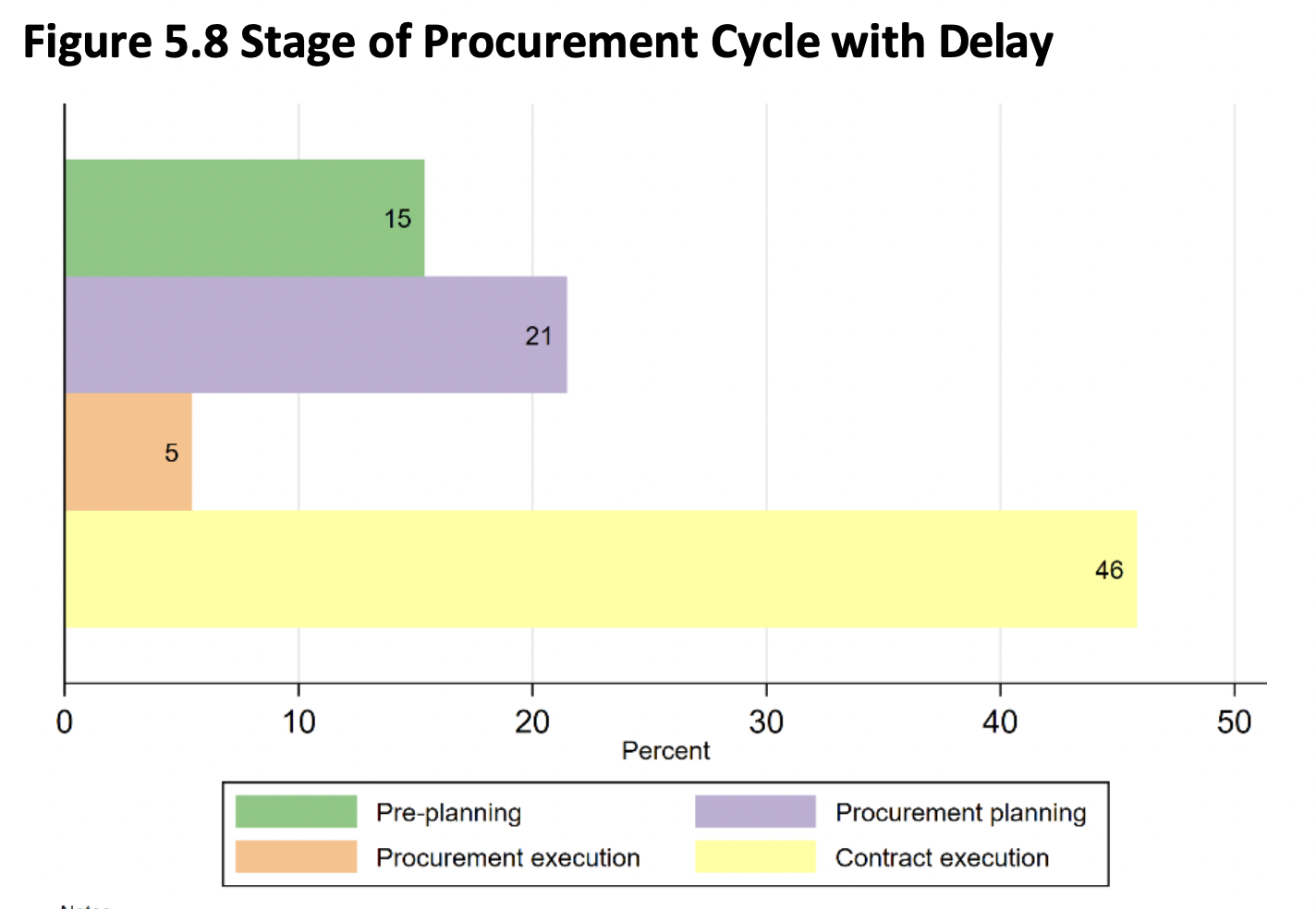
Across 312 World Bank and Islamic Development Bank contracts, 46% of delays occurred during contract execution and 36% during pre-planning and pre-tender stages.
That means more than 80% of delays happened either before the tender was issued or after the contract was signed.
Only 5% occurred during the actual tender process.
— World Bank / IsDB Procurement & Contract Management Assessment (Figure 5.8 context)
The principal risk facing national energy transition programmes is not procurement mechanics — it is architectural fragility. Fragility rarely presents as immediate breakdown. It emerges gradually. Through grid congestion that was not modelled at scale. Through tariff pressures that erode political support. Through regulatory revisions that unsettle long-duration capital. These are not technological problems. They are design problems.
Further evidence from grid interconnection trends illustrates the point concretely. In markets with high renewable penetration, bulk-power grid connection backlogs — driven by capacity constraints and planning lag — have grown to multiples of the existing fleet capacity, revealing that allowing assets to proliferate without corresponding system preparation creates material delivery risk.
Capital providers are increasingly sensitive to this distinction. Infrastructure finance now depends less on whether technology performs and more on whether market frameworks will remain stable across the lifetime of assets. Long-duration capital requires confidence that institutional arrangements will remain aligned across electoral cycles and fiscal constraints. Where system-level architecture is weak, replication slows and capital costs rise.
At sovereign scale, energy transition is not primarily an engineering challenge. It is a statecraft challenge. It requires coordination across treasury, energy, planning, regulatory and industrial ministries. It requires aligning grid expansion with generation targets, designing revenue frameworks before financial close, and establishing accountability at system level rather than at project level. Above all, it requires deliberate system-level orchestration across capital, regulation and infrastructure so that deployment expresses strategy rather than substitutes for it.
Installed capacity is a visible metric. System coherence is a strategic one.
The current phase of the global transition is characterised by technological maturity and capital enthusiasm. What remains uneven is institutional design discipline at national scale. If this imbalance persists, nations risk accumulating infrastructure without achieving structural resilience. Complexity will deepen, cost allocation pressures will intensify, and political credibility will strain under uneven distribution of benefits and burdens.
The next decade will not be defined simply by how many clean megawatts are installed. It will be defined by whether those megawatts operate within durable, well-sequenced systems. Deployment-driven transitions may scale assets; architecture-driven transitions will secure systems.
The energy transition is not the acquisition of cleaner equipment. It is the redesign of national energy systems.
Without architecture, acceleration produces accumulation. With architecture — and disciplined system-level orchestration — it produces structural strength. The distinction will determine which nations secure durable energy sovereignty and which merely assemble infrastructure without systemic coherence.